

Spirit of the Downs: Wilmington Priory and views of the Long Man
By Weird Walk
In October 1986 an unusual experiment took place in the Sussex countryside. A paranormal researcher gathered a group of test subjects within the outline of a giant hill figure marked out on Windover Hill on the outskirts of the village of Wilmington.
At nine o’clock precisely, in the chill autumn darkness, the volunteers inside the figure psychically projected images to colleagues across the country, some of whom were sited at the Cerne Abbas Giant and Avebury’s Neolithic henge. Other ‘receivers’ were stationed directly below the geoglyph in Wilmington Priory and its adjacent church.
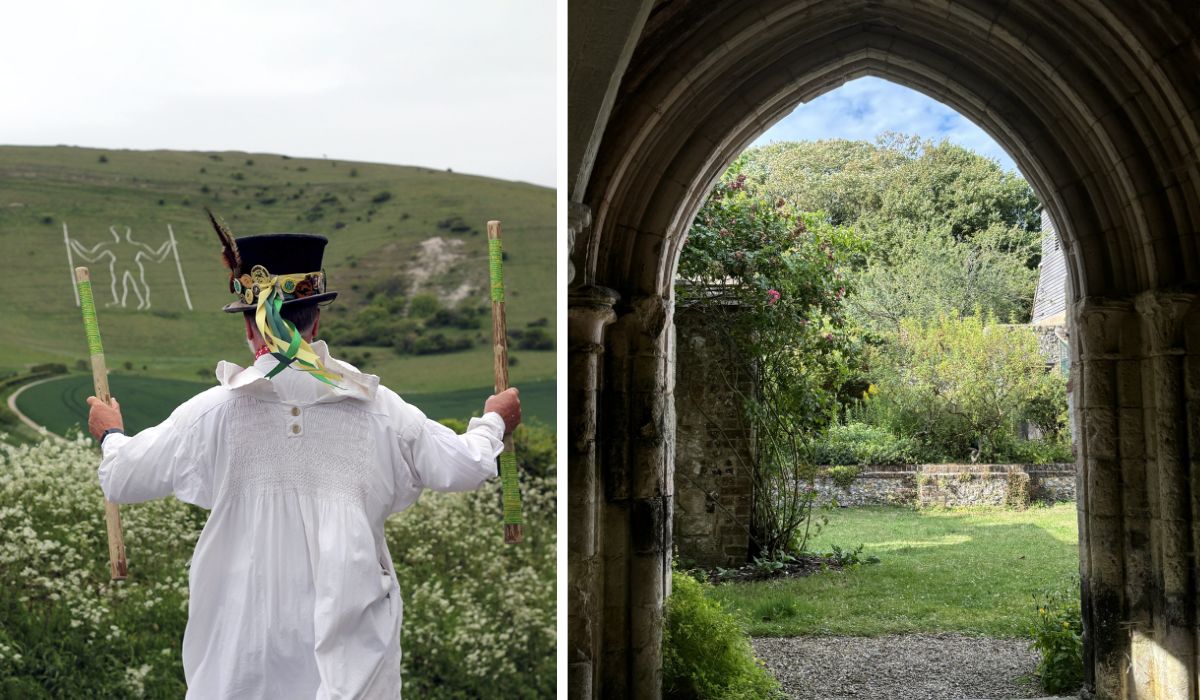
The idea of such an experiment conjures thoughts of the kind of television series that had infiltrated the airwaves of the prior decade, when Children of the Stones brought landscape magic to a generation of schoolchildren and even Doctor Who was tinged with folk horror. We can imagine the camera zooming in and out on those darkened figures, locked in psychic concentration, while a shrill electronic soundtrack scores the action. Everyone is wearing flares.
The results of the Wilmington experiment were, sadly, inconclusive. Yet, the chosen location is revealing. The hill figure known today as the Long Man of Wilmington is undoubtedly this place’s genius loci, serving a similar function to Cerne’s giant, albeit with some key (and unsubtle) differences. The Long Man is a magical presence – the Downs’ enigmatic sentinel, and a source of speculation and inspiration since he first appeared who knows when. It is no wonder that he was seen as the perfect spot to intensify a little telepathic projection.
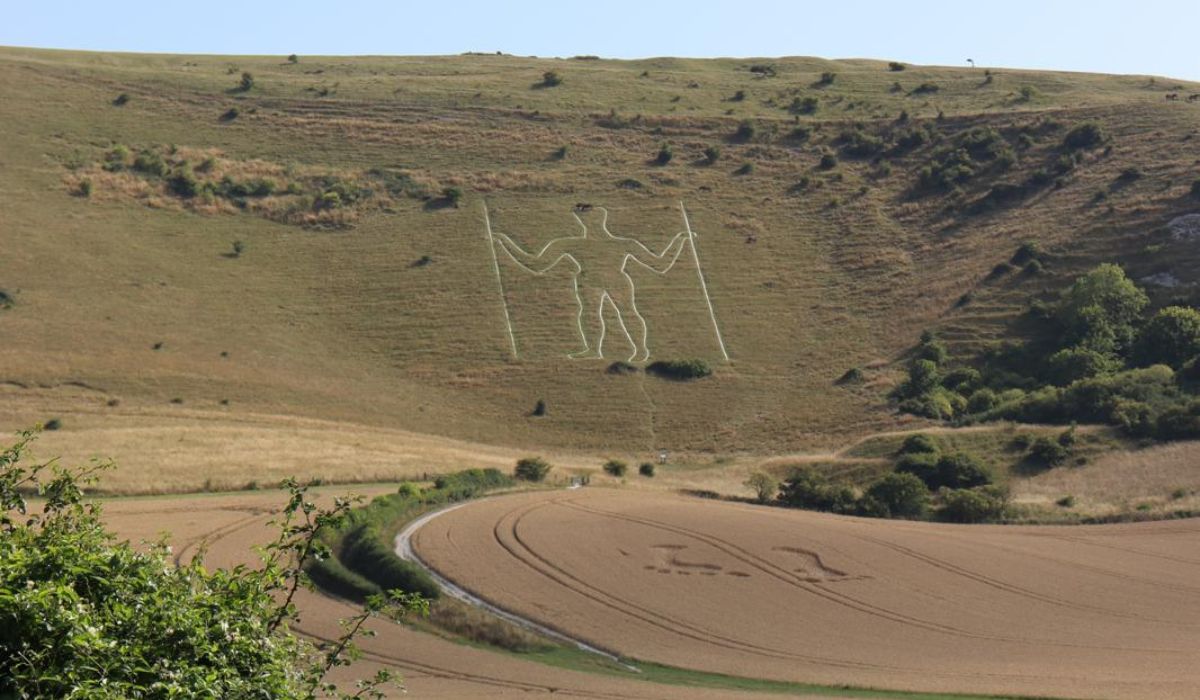
Today, the Long Man remains a wondrous sight to behold. He stands some 72 metres tall, a human figure in simple outline, holding a staff in each hand. On our visit, crop formations provided two footprints below the figure, making it even easier to imbue the giant with life and imagine him striding from his post when unobserved. A dizzying array of theories have been put forward to explain his origin and purpose, many of which are captured in Paul Newman’s 1987 book Lost Gods of Albion, which takes a deep dive into Britain’s chalk figures. (Although, these days, the Long Man is formed from painted concrete blocks rather than cut into the turf or chalk.)
Lost Gods of Albion explores hypotheses which include identification of the Long Man with the Hindu deity Varuna, Constatine the Great (with the figure being cut by Roman soldiers stationed nearby), Beowulf (swap Romans for Saxons) and a Neolithic sun-god. This latter suggestion is presented particularly vividly – the geoglyph representing “the sun-god opening the dawn portals and letting the ripening light flood through.” In this interpretation the Long Man is the herald of high summer, “the spiritual embodiment of John Barleycorn”, with his staves forming a doorway. Such a vision links neatly with modern notions of the Long Man as the Green Man of fertility lore. It is said that the giant was once known locally as the Green Man, and was literally green in the second world war, painted to prevent landmark identification by the Luftwaffe.
Wilmington Priory
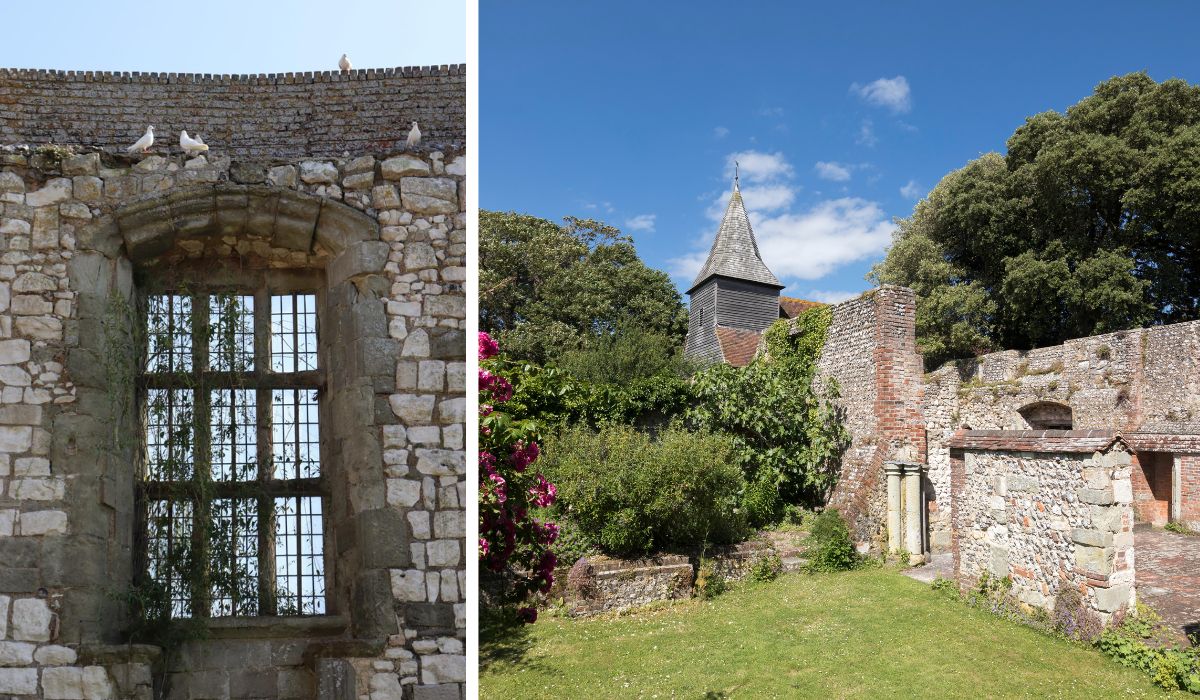
Any ancient, and therefore pagan, origin for the Long Man must reckon with the fact that the figure stood, like Cerne’s engorged giant, next to a notable religious house for a considerable time. Parts of Wilmington Priory date to around 1225, with additions throughout the centuries, including the impressive south wall of the great chamber, with its staircase towers, built in the fifteenth century, and still standing today. Originally, an ‘alien priory’, it was used by its parent house in Normandy to administer its English estates, the monks acting much like land agents. Soon after the Reformation, the building was granted to Sir Richard Sackville, and passed down through marriage and inheritance until 1925, when it was presented, along with the Long Man, to the Sussex Archaeological Society. After a spell as a museum of rural life, the priory was taken on by the building conservation charity the Landmark Trust in the 1990s. An incredibly complex restoration project began in 1999, dealing with architectural alterations and additions from every century since the thirteenth. Today, the property can be booked as accommodation and staying in this remarkable place full of hidden features allows for much rumination on historical juxtaposition and continuity below the figure of the Long Man.
Ley line theory
Wilmington Priory’s location next to the hill figure was a gift to ley line enthusiasts, who were able to plot an alignment taking in a Bronze Age barrow high on Windover Hill, the Long Man himself, the priory, and the church of St Mary and St Peter next door. Alfred Watkins had proposed the ley line theory in the 1920s, following his revelation that significant sites were often aligned on dead straight lines across his home county of Herefordshire. As he explored, he discovered further alignments in other areas. In several books, most notably 1925’s The Old Straight Track, he suggested that these connections were not mere chance – they were an echo of a system of trackways that once extended across Britain, with the markers used for ‘sighting’ the construction of the tracks commemorated in the landscape, although the original significance of each spot had now been lost. He used a suffix often associated with these places (-ley) to name his idea.
Although Watkins’ ley line theory was rejected by academia, it was embraced by amateur explorers of the landscape, adding a detective-like frisson to the increasingly popular post-war pastime of rambling. After Watkins’ death in 1935, leys would fade from view, only to be reborn in the 1960s and 70s with a more mystical emphasis. Ley lines as expounded by writers such as John Michell and Paul Screeton were no longer simple trackways, but conduits of earth energy, available to the ancients but whose secrets had been forgotten by the modern world. Indeed, leys were given as the reason our self-styled paranormal researcher, Kevin Carlyon, chose Windover Hill for his telepathy test.
The Long Man holds a special place in the hearts of ley hunters. In The Old Straight Track, Watkins had suggested that the figure was an image of a prehistoric surveyor of ley lines, complete with sighting staffs. This ley-man would be seen as a man “of position and power, and their staff would become a sign of such a position.” The Long Man, Watkins observes, is a “fitful glimpse” of the work of such an individual. When outlining the Long Man ley line in their 1979 book, The Ley Hunter’s Companion, Paul Devereux and Ian Thomson state that Wilmington Priory’s crypt, an atmospheric space still accessible as part of the property, was once thought to be linked by tunnel to the final point on the ley, the church of St Mary and St Peter. “If so, it would have had to run precisely along the course of the ley,” they note.
Wilmington’s church is dominated by an ancient yew tree, a regular sight in British churchyards, but this one is particularly massive, its weight supported by various wooden posts and long-rusted chains. It is thought to be older than the twelfth-century church itself. Inside the building, our attention was drawn to a curious carving, the ‘Wilmington Madonna’, which was removed from an exterior wall in 1948. According to the church guidebook, the seated figure has been treated to several interpretations, most recently being identified as an early Norman image of Mary after being given a good clean. Tantalisingly, and in true church guidebook fashion, we are also introduced to the James Frazer-style suggestion that “an even earlier date for this carving is not improbable and could suggest a connection with some pagan fertility cult.”
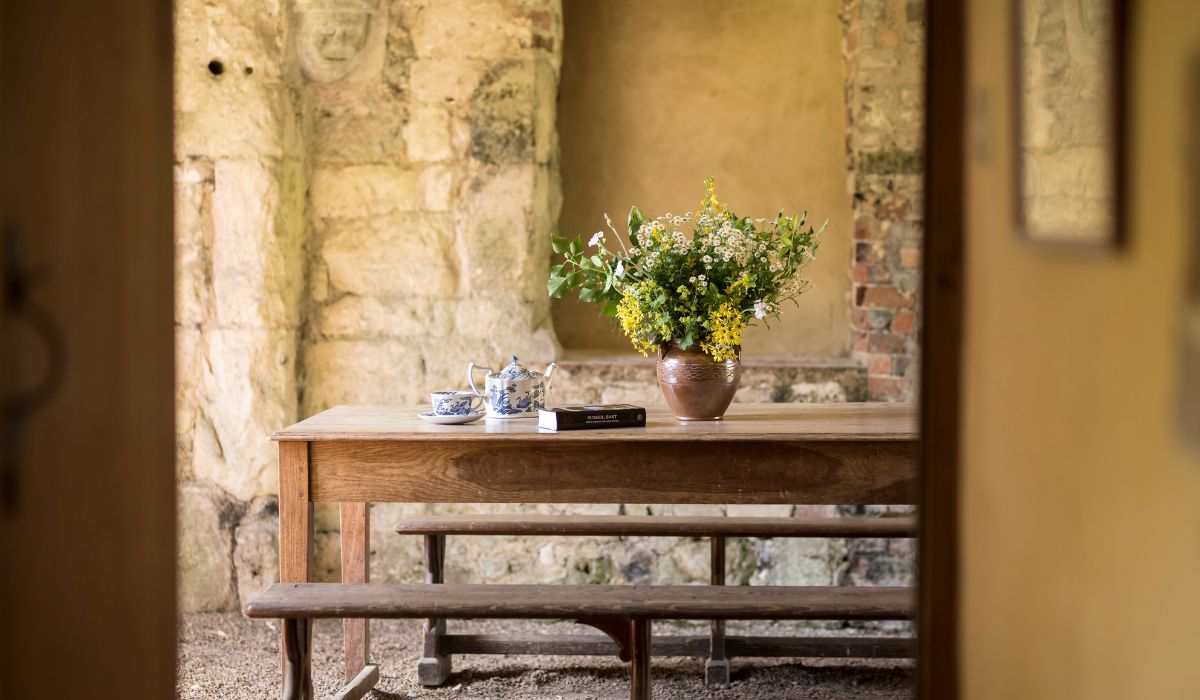
Wandering back towards the priory, thoughts turn to the most recent archaeological investigation on Windover Hill. Unlike the theories expounded in Lost Gods of Albion, a well-thumbed copy of which sits on the priory’s bookshelves, this excavation suggests that the Long Man may be much later than previously imagined. A Tudor date has been tentatively proposed for the figure, which may, it seems, have always been formed of bricks rather than the chalk of the Downs. Such a date has again led to conjecture; could the figure now be Christ opening the doors of heaven or a Protestant martyr tortured on the rack?
Ultimately, we all love a mystery, and each intriguing glimpse of the Long Man’s origins sees us, like those eighties telepathy subjects, projecting our own images in the darkness. As the South Downs’ quintessential amateur-historian, Reverend A. A. Evans once noted, “The Giant keeps his secret and from his hillside flings out a perpetual challenge”
Weird Walk is a journal of wanderings and wonderings from the British Isles.


