

The journey to save Mavisbank
In 2024 we were delighted to announce a major grant from the National Heritage Memorial Fund to rescue Mavisbank. We’re now embarking on what will be a long journey to secure its future.
Overview
A major grant received to rescue Mavisbank
Campaigners have laboured for decades to save the 300-year-old architectural gem in Midlothian, Scotland, from collapse following a catastrophic fire 50 years ago. Its terrible condition and uncertain ownership had left this ‘Category A’ masterpiece in a derelict and highly perilous state.
Our breakthrough came in May 2024 with the award of a grant from the National Heritage Memorial Fund to rescue the building. Landmark has been working with Midlothian Council, Historic Environment Scotland, the Mavisbank Trust and others to identify a viable solution to Mavisbank’s woes for many years and made the application in January 2024, believing the house met the criteria of being of ‘outstanding importance to the national heritage’.
Planning consents
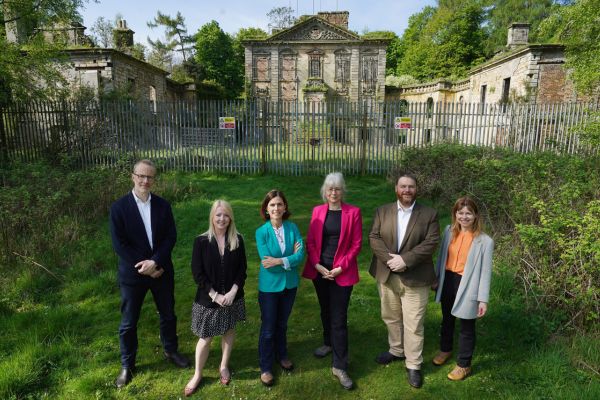
In April 2026, planning consent was given for the drive, and with planning and listed building consent for repairs to the house already in place, the Compulsory Purchase of Mavisbank can now proceed.
A brighter future on the horizon
The vital first phase will see the crumbling building and pavilions stabilised before any more historic fabric falls away, enable up-to-date condition surveys and resolve the long-standing, hugely complex ownership and access issues.
At the end of 2024 we appointed key members of the team who will lead on rescuing and restoring this internationally significant building. Each contract has been awarded following a competitive procurement process advertised via Public Contracts Scotland, administered by Ingham Pinnock Associates and Brodies LLP.
- Morham and Brotchie’s Edinburgh office has been appointed as specialist conservation quantity surveyor. Their previous projects include the Robbie Burns Museum, Penicuik House and Grassmarket Community Project.
- Environmental consultancy Ironside Farrar, with offices in Edinburgh and Glasgow, has been appointed the project’s landscape architect and civil engineer, which includes scoping and developing the new access drive to the currently marooned site. Their team led the masterplanning and landscape design of Helix Park and the Kelpies in Falkirk and are currently working with the Royal Botanic Garden Edinburgh.
- LDN based in Edinburgh were successful in a highly competitive tender process to lead design services on the House. Their work has included working with Calderdale Council to transform the Piece Hall in Halifax, the restoration of Provan Hall in Glasgow and the regeneration of Riddle’s Court in Edinburgh’s Old Town.
The long journey to save Mavisbank will have many stages, including:
- 2024-2025 Acquisition process for the ruins of Mavisbank House led by Midlothian Council, the local authority. In February 2025 the Council issued an Urgent Repairs Notice: legal commencement of the Compulsory Purchase process.
- 2026-2027 Phase I: Landmark will take ownership of the house and work can start on repairing the standing masonry, liaising with Historic Environment Scotland (in whose care the policies sit) to create the access route to the marooned site and make the building safe to visit.
- 2029 Phase II begins, if funds can be raised, with reroofing, restoration of interiors with extensive opportunities for people to participate, learn traditional skills and follow the work in progress. The end use is expected to be a mixture of accommodation for short residential stays and public access, including regular free open days.
Community engagement aspirations
Landmark aspires to deliver high quality training opportunities for people from all backgrounds. We hope to run traditional craft skills taster days for local secondary schools, work experience and apprentice placements with our main contractors, and CPD webinars sharing the expertise being developed on our project with the wider industry.
For our local communities, we will offer family friendly volunteering opportunities, public hard hat tours, behind the scenes scaffold tours, and talks about the history and stories of the building and the people who have lived and worked there.
All activities will be listed here on our website, communicated via our mailing list and engagement social media channels.
-

Neglected for 50 years
The ornate architecture of the building is still visible as it crumbles into further disrepair.
-

Derelict inside and out
Remnants of the original interior can be seen, surrounded by overgrown foliage and crumbling walls.
-

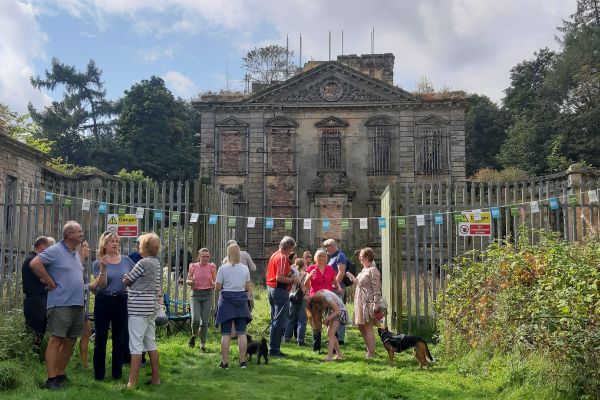
Doors Open Day tour 2023
A group from the local community on a guided tour of the site
-

A bird's eye view
Pictured from above, the main mansion is adjoined to two smaller buildings.
-

Across the centuries
The front exterior of Mavisbank pictured in the late 19th century.
Join the journey
The National Heritage Memorial Fund grant is the major enabler in a total £7.8m funding package of which 94% is secured, including £1.995m raised to date from various other sources, including the Landmark Trust’s own funds. To complete the project we must raise a further £505,000– and for this we need your help.
Those pledging £10,000 or more to the first phase will be honoured as Rescue Guardians of Mavisbank and will play a crucial role in laying the foundations for its future. To find out more about becoming a Guardian, contact Bruce Hall ([email protected]) or Hatty Masser ([email protected] in our Development team.
All support for Mavisbank is gratefully received.
We thank all who have already supported the project to rescue Mavisbank House, including those have chosen to remain anonymous.

History
The history of Mavisbank House
Mavisbank was built from 1723-7. It was designed architect William Adam, and his client, Sir John Clerk of nearby Penicuik. Clerk absorbed European culture during his Grand Tour in the 1690s, and at Mavisbank he created his vision of a classical villa for civilised retreat to the countryside, situated within a beautiful valley that he gently landscaped. Clerk became a major figure in the Scottish Enlightenment after the Union with England in 1707.
The Clerks of Penicuik sold Mavisbank on in 1811. In 1876 the house was bought by a group of pioneering Edinburgh doctors as a private asylum. Dr John Batty Tuke, the asylum’s director, modernised mental health practices by treating it as a medical (rather than a criminal) condition. Mavisbank patients participated in gardening therapies under its remarkable Head Gardener Mary E. Burton, self-educated and the first female professional gardener in Scotland.
The asylum closed in the 1950s and was sold again to a private owner, who used the site as a car breakers yard. A disastrous fire in 1973 was followed by abandonment. The building was left a roofless shell, saved from demolition in 1987 only thanks to public outcry.

Latest updates
Planning secured to begin Phase I
April 2026
We are thrilled that Midlothian Council has approved Landmark Trust's planning application for the driveway to Mavisbank House. With planning and listed building consent for repairs to the house already secured, the Compulsory Purchase of Mavisbank can now proceed.
This will enable Landmark to stabilise and repair the ruinous house, supported by a grant from the National Heritage Memorial Fund and further grants and philanthropic donations.

Planning application approved for the house
January 2026
We are pleased to report that Midlothian Council has approved Landmark's planning and listed building consent application for a vital aspect of the phase one works to Mavisbank house, made all the more acute following recent masonry falls.
We await a decision on the planning application for the creation of a new drive to access the house, without which the building works cannot begin.

Planning applications submitted for Phase I works
June 2025
We're pleased to announce that two planning applications have been submitted for Phase I of the Mavisbank restoration project - a major step forward in our mission to rescue this nationally significant Category A listed building. One application covers essential repair and stabilisation works to the house itself, the other proposes a new access drive to reconnect the stranded property with the local road network at Wadingburn Road.
Frequently asked questions
Where will the access drive be located?
The proposed access drive to Mavisbank House will be off the Wadingburn Road on the outskirts of Loanhead. The access drive will join Wadingburn Road roughly where the 30mph signs are located as you drive into the town. We were previously proposing to create an access drive further east but this was likely to be more technically challenging and was not supported by the local community.
Who is the access drive for?
In the short term the drive will be used for access for specialists working on the stabilisation of the ruin of Mavisbank House. Without this access drive we cannot get to the building to rescue it. We do not have the right to use any of the other drives which were sold off and are in private ownership. Our plan is then to use the drive for a second phase of restoration works that we need to raise funding for that will bring the house back to life to create a Landmark self-catering let.
At completion the drive will then just be used by people staying in or servicing the Landmark; it will not provide general access for people visiting the policies. The access drive will be a single track, around 3.5 metres wide with occasional passing places so that we meet with the relevant regulations. The surface will have a buff finish more in keeping with the historic setting. The drive will have a gate with a code padlock at the entrance off Wadingburn Road to ensure only authorised users can use the track.
Why have you chosen this access route for the drive? Did you consider any alternative routes?
The sale of land and property at Mavisbank over time has left the house landlocked. Numerous different options for re-establishing vehicle access have been considered as part of the project. The route being proposed is the only one which is viable in terms of land ownership, technical feasibility and impact on the historic landscape - and emerged as the clear local preference in community consultation in 2025.
The new drive re-uses as much as possible the historic east drive which hugs the side of the Esk Valley and allows glimpses of Mavisbank on the approach to the house. The precise alignment was closely informed by extensive ecology and tree surveys to ensure any impacts on flora and fauna will be minimised and fully mitigated.
Why does there need to be one access drive for both the restoration of the building and the long term access as a holiday let? Why not have different solutions for each phase?
The cost and impact of creating two entirely new access routes would be prohibitive. Proposing two access drives also creates additional risk that one or the other would not get statutory consent.
Why are you felling trees?
Some felling of trees is necessary to create the new access drive. Currently there is no established legal right of vehicular access to the house and this is one of the main reasons why its restoration has never previously been achieved. No ancient or veteran trees will be removed and sensitive compensatory planting will be delivered.
The planning officer's report that accompanies our application for the access drive clearly recommends the application for approval and states that 'in the longer term, given the nature of the development and sensitive design (in terms of layout, materials and species selection) the development will not give rise to significant adverse visual impacts overall. Furthermore, as the mitigation and enhancement planting matures it will result in an overall beneficial visual effect.'
Will the drive lead to housing development?
Landmark is not a housebuilder or a developer. Our planning application is solely about creating an access drive that will allow us to rescue and the operate Mavisbank House as a holiday let.
What happens if the proposed access route isn’t approved?
If permission is refused for the new access route in spite of a clear recommendation from the planning officer that it should be approved, we would very likely seek to appeal the decision. Ultimately, if an access road cannot be agreed, Mavisbank House will continue to deteriorate and the building will be lost, along with the opportunities that its restoration would unlock such as craft training and local employment.
If you'd like to get in touch, please email [email protected]. For future updates, join the email list on our website: www.landmarktrust.org.uk/mavisbank.
Will the access drive be tarmac?
Our proposal is for the access drive to have a buff / beige finish in order to blend in better with the landscape and have a more historic character. We are still working on the timing of creating the finished surface as in the short term the drive will need to accommodate vehicles working on the restoration which could potentially damage the surface.
How will you stop people from driving down the access drive into the Mavisbank policies?
The access drive will only be used for access to Mavisbank House. During the restoration phase this will be by contractors and once complete, it will only be used by holiday guests, housekeeping staff on changeover days and occasional maintenance contractors. The drive will have a gate with a code padlock at the entrance off Wadingburn Road to ensure only authorised users can use the track.
Where will people park?
Our holiday guests will be provided with parking spaces near Mavisbank House.
During the restoration works contractors will have dedicated parking areas and site compounds to avoid impacting our neighbours.
Once the access drive is constructed contractors will park near Mavisbank House at the work compound.
We continue to work with our local partners to find a solution for parking for visitors and guests during the restoration project and for future public Open Days. All on site events and public access tours will be planned with appropriately restricted numbers to limit the impact of visitor parking on our local neighbours. This is how we have long-managed open days where parking is constrained. All visitors will be given clear instructions of safe parking places.
Will Mavisbank House become a visitor attraction?
No. Landmark’s model is to use our historic buildings as self-catering holiday lets. At Mavisbank our plan is to create one single holiday let in the main building and north pavilion that sleeps six or eight people. We are still exploring ideas for the south pavilion but whatever we do here must be complimentary to the use of the main building and not conflict with guest’s quiet enjoyment of the site.
What about all the bats, badgers and wildlife who call Mavisbank policies home?
Proposals for Mavisbank House and the creation of the access drive will be informed by extensive ecological surveys that consider bats, birds and other protected species as well as specimen trees and important areas of flora. Any works will be designed to minimise any negative ecological impacts and provide mitigation and benefits where we can. The Mavisbank Policies are highly protected which means that every care must be taken at every stage.


